
Rising energy prices and the appeal of energy independence are pushing more households, farms, and remote sites towards off-grid solar. An off-grid system generates electricity independently of the utility network, which makes it a practical option for sites with no grid access or an unreliable supply.
Choosing the right system, however, goes beyond buying panels and batteries. Array size, daily consumption, battery capacity, inverter ratings, and future expansion all have to be matched to each other. This guide walks through the calculations and the mistakes to avoid.
1. What Is an Off-Grid Solar Energy System?
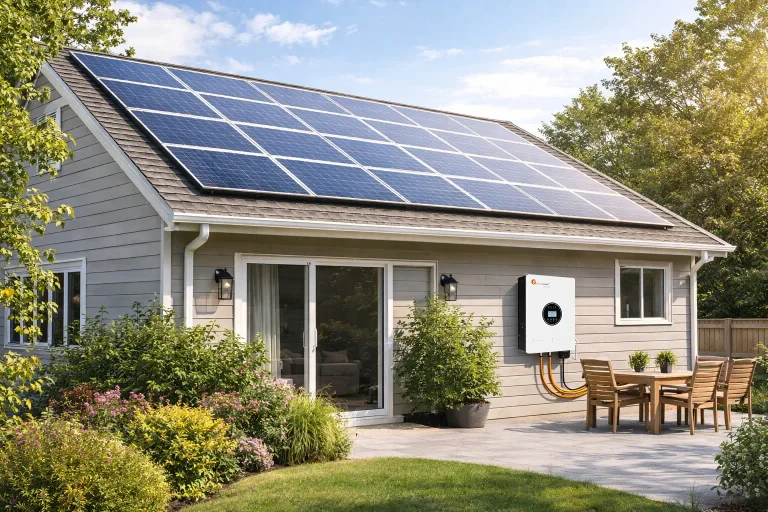
An off-grid solar energy system generates electricity from solar energy and stores the surplus for later use. Unlike a grid-tied system, which depends on the utility network for stability and cannot supply power during an outage, an off-grid system must generate, store, and manage everything the site consumes. With correct sizing and adequate solar and battery resources, it can supply electricity entirely independently of the grid.
A typical off-grid system consists of:
- Solar panels — convert sunlight into DC electricity
- Off-grid inverter — converts DC from the panels and battery into AC for household loads, and manages charging
- Battery storage — stores surplus generation for use after sunset or during extended cloudy periods
- Charge controller — regulates solar charging and protects the battery. In most modern off-grid inverters, including the Felicity Solar IVEM series, the MPPT charge controller is built in, so no separate unit is required
- Protection devices — DC and AC breakers, fuses and surge protection
- Monitoring — remote visibility of generation, consumption and battery status, typically through an app
2. Assess Your Energy Needs Before You Buy
Calculate Your Daily Electricity Consumption
Start with actual consumption. An inaccurate estimate can lead to either a system that cannot carry the load or unnecessary capital spend.
List every appliance and record:
- Its power rating in watts
- How many hours per day it runs
- Whether it has a high starting surge (pumps, compressors, air conditioners)
- Any loads you expect to add later
As a rough guide, a small off-grid home or cabin typically uses 3–5 kWh per day, while a larger household with air conditioning, water pumps and multiple appliances may need 20 kWh per day or more.
These figures drive every subsequent decision: array size, battery capacity and inverter rating.
Check Solar Availability at Your Site
Solar output depends entirely on local irradiation. Most locations receive roughly 3 to 6 peak sun hours per day. High-irradiation regions — the Middle East, parts of Australia, southern Europe in summer, the south-western United States — can reach 6 to 7 hours, while higher latitudes and cloudier climates may see only 2.5 to 4.
Seasonal variation matters more than the annual average. A site might average 5 peak sun hours across the year but drop to 3 in midwinter. Off-grid systems should be sized on the lowest monthly figure, not the annual average; otherwise, the system will fail exactly when it is needed most. Local solar irradiation data, roof orientation, tilt angle, and shading should all be assessed before the design is fixed.
3. How to Size the System
Determining Solar Array Capacity
Array size follows from daily consumption and available sunlight:
Array capacity (kW) = Daily consumption (kWh) ÷ Peak sun hours ÷ System efficiency
For example, a home using 6 kWh per day, with 5 peak sun hours and a system efficiency of 80%:
6 ÷ 5 ÷ 0.8 = 1.5 kW
A 1.5 kW array covers the calculated demand. In practice, additional capacity is normally added — typically 20–30% for residential systems and 25–40% for commercial ones — to cover system losses, cloudy days and seasonal shortfall. Where the design is based on the worst month rather than the annual average, the required margin is smaller.
Choosing Battery Storage
Battery capacity determines how long the system runs without sun. Four factors drive the calculation:
- Nighttime and low-solar demand — the energy that must come from the battery rather than the panels
- Autonomy days — how many consecutive cloudy days the system must ride through; two to three days is a common starting point for residential off-grid
- Depth of discharge (DOD) — the share of rated capacity that can actually be used. LiFePO4 batteries such as the Felicity Solar FLA48206WG1-EU are rated at ≥95% DOD, against roughly 50% for typical lead-acid, so a lithium bank delivers close to twice the usable energy for the same rated capacity
- Cycle life — Felicity Solar’s LiFePO4 batteries are rated for at least 6,000 cycles at 25 °C, which, at one cycle per day, represents well over a decade of service
LiFePO4 batteries generally offer longer cycle life, greater thermal stability and better charge efficiency than lead-acid batteries, and require no routine maintenance.
Selecting the Inverter
The inverter manages energy conversion and power supply, so it sets the ceiling on what the system can do.
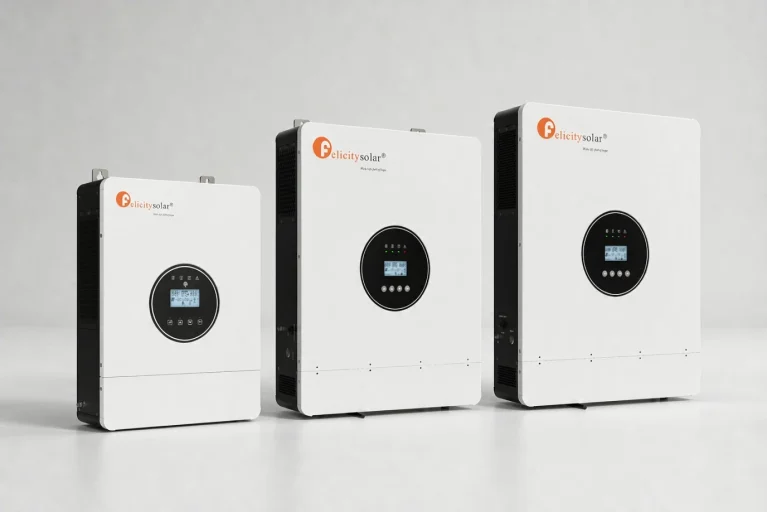
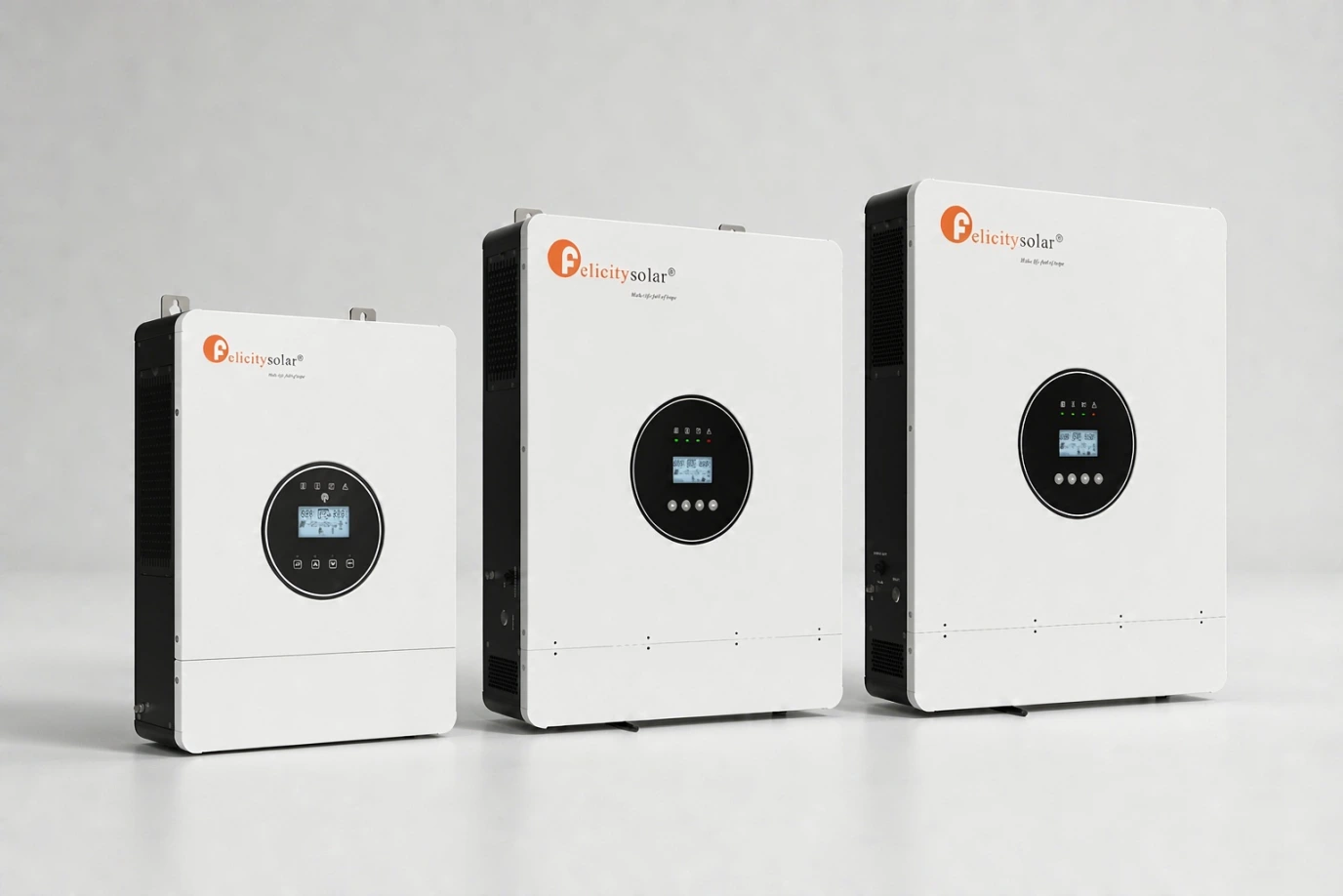
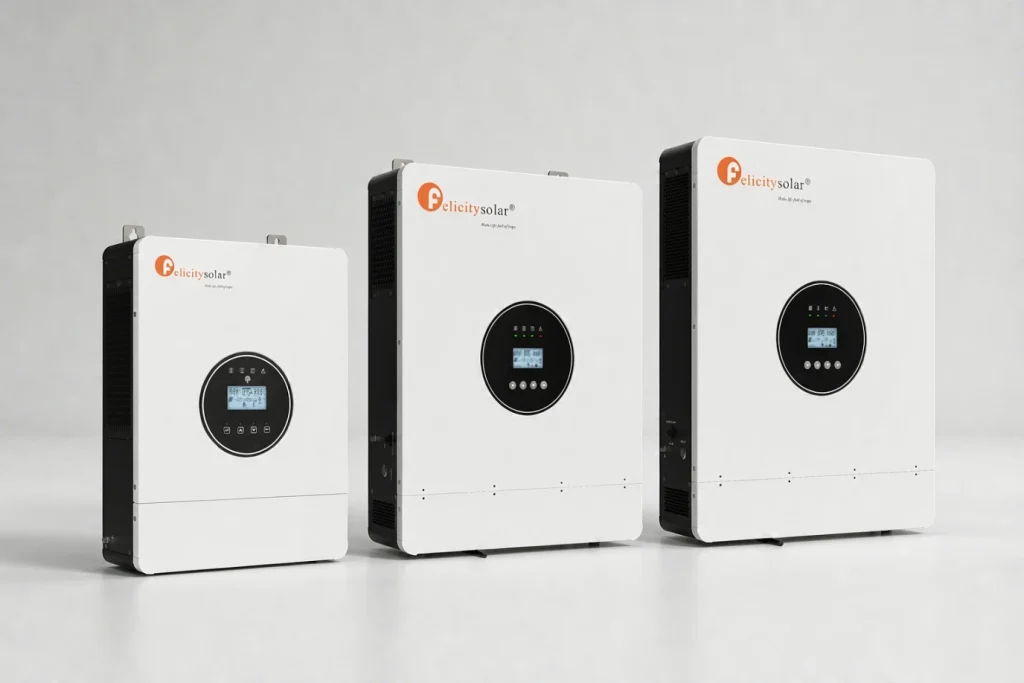
The Felicity Solar IVEM4024-II is a 4 kW single-phase off-grid inverter designed for residential and small-scale applications. It combines a pure sine wave inverter, an MPPT solar charger, and a battery charger in one compact unit, which reduces both equipment count and wiring (In Latin American markets, the equivalent model is the IVEM4024-SAll.
| Parameter | IVEM4024-II |
| Rated output power | 4000 VA / 4000 W |
| Nominal DC input voltage | 24 V |
| Output waveform | Pure sine wave, 230 Vac ±5% |
| PV operating voltage range | 60 – 500 VDC |
| Max. PV open-circuit voltage | 500 VDC |
| Max. PV input power | 6000 W |
| Max. PV input current | 27 A |
| Max. charging current (PV + grid/GEN) | 120 A |
| AC input voltage range | 90 – 280 Vac |
| Utility / generator charging | Supported, 10 – 120 A adjustable |
| Monitoring | Built-in Wi-Fi, remote monitoring via the Fsolar app |
| Certification | CE-EMC, IEC 62109-1/2 |
A 4 kW / 24 V unit of this type suits cabins, small homes and sites with a modest connected load. With the MPPT controller and AC charger built in, it also works where a generator or intermittent grid supply is available for supplementary charging, and it can run without a battery in pass-through mode.
For larger loads, the same IVEM-II platform scales up: the IVEM8048-II delivers 8 kW at 48 V with a peak efficiency of 94.5%, supports up to six units in parallel for a maximum of 48 kW, and offers a 10 ms transfer time in UPS mode.
4. Recommended Configurations by Application
Small Homes, Cabins and Outdoor Sites
For cabins, holiday homes and remote outdoor equipment, a compact system is usually sufficient.
Typical configuration:
- Solar array: 500 W – 2 kW
- Battery storage: 2 – 5 kWh
- Inverter: IVEM3024 or IVEM4024-II (3 – 4 kW, 24 V)
This supports lighting, communication equipment, a refrigerator, and small appliances.
Permanent Residential Sites
A full-time home needs a larger system to deliver stable daily power.
Typical configuration:
- Solar array: 3 – 8 kW
- Battery storage: 5 – 20 kWh
- Inverter: IVEM8048-II (8 kW, 48 V) or larger
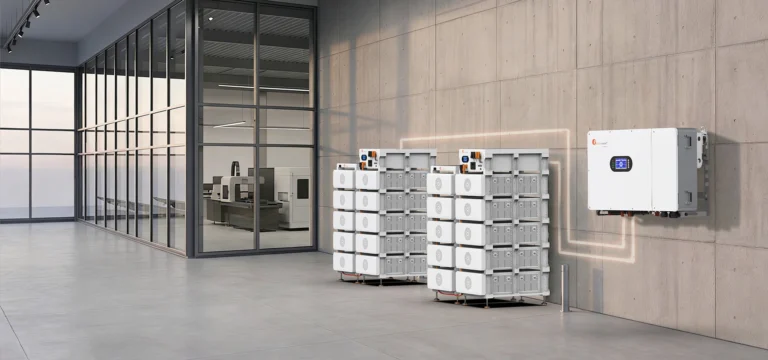
A common pairing is the IVEM8048-II with a FLA48300 15 kWh LiFePO4 battery (51.2 V, ≥6,000 cycles, expandable to 225 kWh with up to 15 units in parallel). This covers air conditioning, water pumps, kitchen appliances, and home office equipment, with room to expand.
Farms and Remote Commercial Sites
Agricultural facilities and remote commercial sites often need power for long operating periods and heavy starting loads.
These applications typically require:
- A larger array, sized on the worst-month irradiation figure rather than the annual average
- Higher-capacity storage with two to three days of autonomy — the FLA48300 scales to 225 kWh with 15 units in parallel
- A higher-power inverter, or several in parallel — the IVEM8~12048-II supports up to six units for a maximum of 72 kW single-phase
- A generator input as a fallback for extended cloudy periods; the IVEM series accepts utility or generator charging
A properly designed off-grid system can reduce dependence on diesel generators while delivering a cleaner, quieter and lower-maintenance energy supply.
5. What to Avoid When Selecting an Off-Grid System
Ignoring Component Matching
The array, battery, and inverter must be matched on three points:
- System voltage — a 24 V inverter requires a 24 V battery bank; a 48 V inverter requires 48 V
- PV input limits — the array’s open-circuit voltage must stay below the inverter’s maximum (500 VDC for the IVEM4024-II), and the array’s working voltage must fall inside the MPPT range (60 – 500 VDC)
- Communication protocol — the inverter and battery BMS must speak the same language (CAN or RS485) so the inverter can read state of charge and apply the correct charging profile
Oversized or mismatched equipment reduces efficiency, triggers faults, and increases cost.
Focusing Only on Initial Price
The lowest upfront price rarely delivers the lowest lifetime cost. Efficiency, protection functions, cycle life, warranty terms, and local technical support all determine what the system actually costs over ten years. A cheaper battery rated for 1,500 cycles will need replacing several times during the life of a 6,000-cycle LiFePO4 unit.
Forgetting Future Expansion
Consumption tends to grow. Check the maximum parallel capability before buying, so capacity can be added later without replacing the core equipment. The IVEM8~12048-II supports up to six units in parallel, and the FLA48300 up to fifteen — but parallel limits vary by model, so always check the datasheet for the specific unit.
Conclusion
Sizing an off-grid solar system properly requires detailed planning around four things: actual daily consumption, real solar availability at the site (using the worst month, not the average), storage capacity with enough autonomy for cloudy periods, and correctly matched equipment.
Felicity Solar has been manufacturing solar and energy storage products since 2007, and supplies off-grid inverters, hybrid inverters, LiFePO4 battery packs, all-in-one energy storage systems and commercial storage to customers in more than 100 countries. The IVEM off-grid inverter series runs from 3 kW to 12 kW per unit, with parallel capability up to 72 kW.
If you need help selecting an off-grid system, inverter or battery, contact Felicity Solar — our technical team can review your load list and site conditions and recommend a configuration. The online system configuration tool also lets you model options yourself before speaking to an engineer.
FAQ
1. How many solar panels do I need for an off-grid system?
Divide daily consumption in kWh by peak sun hours, then divide by system efficiency (typically 0.8), and add a margin of 20–30%. A home using 6 kWh per day with 5 peak sun hours needs about 1.5 kW of panels by calculation, or roughly 1.8–2.0 kW once the margin is included. Use the lowest seasonal sunlight figure for your site, not the annual average.
2. How many batteries do I need to go off-grid?
Work out how much energy must come from storage overnight, then decide how many autonomy days to cover. Multiply daily storage demand by autonomy days, and divide by the usable capacity of the battery (rated capacity × depth of discharge). A 15 kWh LiFePO4 battery at 95% DOD delivers about 14.25 kWh usable, so two days of autonomy for a 7 kWh nightly load needs roughly one FLA48300.
3. Can an off-grid solar system work in winter or during long cloudy periods?
Yes, if it is sized correctly. The two common causes of winter failure are sizing on the annual average instead of the worst month, and insufficient autonomy days. A generator input as a fallback also helps: the Felicity Solar IVEM series accepts utility or generator charging, so a short generator run can restore the battery during an extended cloudy spell.
4. Do I need a separate charge controller?
Usually not with a modern off-grid inverter. The Felicity Solar IVEM series has the MPPT solar charge controller built in, together with the inverter and the AC battery charger, so a single device handles all three functions. A separate controller is only needed when the inverter does not include MPPT, or when the array is sized beyond the inverter’s PV input limit.
5. What is the difference between an off-grid inverter and a hybrid inverter?
An off-grid inverter, such as the IVEM series, is designed to run a site independently of the grid — it forms its own AC supply from the battery and panels, and can accept utility or generator input for charging. A hybrid inverter, such as the IVGM series, is designed to work in parallel with the grid, exporting surplus and importing as needed, with battery backup during outages. If there is no grid connection at all, an off-grid inverter is the correct choice.
6. How do I monitor an off-grid system remotely?
Through the Fsolar platform. IVEM series inverters have Wi-Fi built in, so generation, consumption, battery state of charge and alarms can be viewed from a mobile app or web portal — useful for remote sites that are not visited regularly.